Member for

8 months 3 weeks
Off
Image
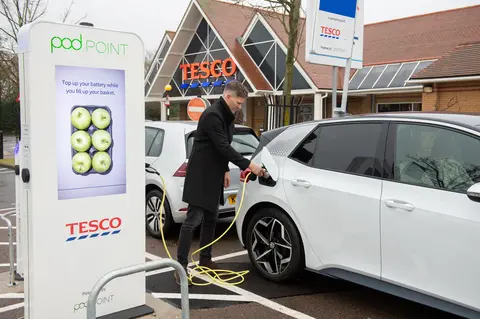
Man Charging an EV in a Tesco car park

A guide explaining the energy mixture of electricity used by public electric car chargers, including how much of that comes from renewable energy, and how to tell. 

Is it possible for public charging stations to use renewable energy?
H2

Simply put: yes, it’s entirely possible, and they likely do! But to understand why, it makes sense to take a look at how the UK’s energy system works. 

With the goal of reaching net zero by 2050, the UK’s energy sector has invested heavily into making the energy it generates more sustainable and less reliant on burning polluting fossil fuels. The ultimate aim is to have an electricity system built on 100% zero-carbon energy, much of this expected to come from renewable sources including the wind and Sun. 

The UK’s use of renewable energy has been steadily increasing over the last few decades, rising from around just 2% in 1991 to well over 40% in 2025, with a peak of 51% in 2024. This means that it’s very possible that EV public charging systems are at least in part powered by some form of renewable energy. 

How can you tell if a public charger is using renewable energy?
H2

The reality is, it’s actually very difficult, if not impossible, to tell whether the public charger you’re using is currently – or at all – uses electricity generated from renewable sources. 

There may be some niche instances where it’s obvious, such as if the charger has solar panels attached to it or some form of branding indicating its use of renewables. But for the most part, public chargers are not functionally dissimilar to home chargers, in that they’re dedicated ports to charge electric cars. That’s not to say it won’t be using renewable energy – again, it’s likely that it does – but there’s no way to be completely certain. 

Do EVs charge slower when filled with renewable energy?
H2

Just like anywhere else, what source your electricity comes from – be it a renewable source like solar energy, or by burning fossil fuels – has no impact on how it works. So the simplest answer to this is a resounding no: your electric car won’t charge any slower (or faster, sadly!) if it’s being powered by renewable energy. But it will be greener though! 

What is the most eco-friendly way to charge your EV?
H2

Electric vehicles are already great for the environment, and this is doubly the case if it can be charged using renewable energy. 

Unfortunately, whilst charging out and about – whether that’s in public, or at work – is a great way to keep your EV topped up, and likely involves the use of some amount of renewable energy, drivers don’t actually have any way to control this. It would be lovely if we knew with absolute certainty that when charging in public our EVs were being filled with lovely green energy, but that simply isn’t the case. 

However, it can be the case at home, where we have more – although, still limited - control over what kind of energy we use, and when and how we charge. 

More specifically, the most eco-friendly time to charge is overnight. This is because energy demand is lowest overnight as we’re all (more or less) asleep, meaning we don’t need as much electricity from the energy grid. This in turn means the grid won’t need to turn on extra fossil fuel-burning generators to meet demand, making it a green time to charge. 

Plus, there are some ways we can personally increase the amount of renewable energy in our home. One such way is using solar panels and pairing them with a solar compatible charger to charge you electric car using zero carbon (and potentially free) solar energy. 

Tip: the Solo 3S home charging system is our award-winning and solar compatible home charger. It can be purchased upfront from £849, or included in the Plug & Power Bundle which reduces the upfront cost to £499 and spreads the remainder across an exclusive 2-year fixed low-cost energy tariff supplied by EDF. 

Article read time
3 min read
H6
Summary
H2

Generally speaking, some of the electricity used at a public electric vehicle charging station will have been generated from renewable energy sources. This is because the UK’s energy network at large generates a significant amount from renewables. However, it’s not possible to know exactly how much energy you use when charging in public has come from a renewable source. 
H6
Off

Member for

8 months 3 weeks
Off
Image
pod point installer installing a new pod point ev charger
Categories

This complete guide covers everything you need to know about all the costs associated with installing an EV charger at home.

What’s included in the cost of a home EV charger?
H2

When you buy an electric car charger for your home, there are a few things that factor into the home EV charger installation costs:

The charger

Obviously a key component of the cost of is the charger itself, which can vary across providers and charger types, with smarter and more high-tech chargers usually costing more. For example, our award-winning Pod Point Solo 3S home charging system starts from £999.

Image
lightbulb icon

Tip: alternatively, you can get a Solo 3S charger for just £499 upfront with the rest spread across a fixed 2-year low-cost energy tariff supplied by EDF through the Plug & Power bundle.

#F2F5CF
#000000
H6

Installation

Home chargers need to be installed by professional and qualified electricians to ensure they’re installed correctly and safely. No matter where it’s installed, from the side of your house to the inside of your garage, this understandably comes at a cost to cover labour, materials, and any other costs that you may incur due to the nature of the installation. For example, more complex installations typically cost more as they often require more labour or additional materials like cabling or trunking to complete the installation.

Image
lightbulb icon

Tip: the price of a Solo 3S includes the cost of installation if it meets out standard installation criteria, so when you order yours you won’t be hit by any hidden costs. Order your Solo 3S today.

#F2F5CF
#000000
H6

Power supply panel upgrades

Most homeowners tend to have a 7kW home EV charger installed, which is more than sufficient for most charging needs. These rarely require upgrades to the home’s power supply to be installed, but older properties with older electrical panels may need an upgrade. Similarly, if you’re going for a faster 22kW you’ll likely need to upgrade your power supply as these chargers need three-phase power, where the majority of homes in the UK have single-phase power.

Optional extras

As mentioned, more advanced home chargers will likely incur a higher cost, especially smart chargers that give homeowners great control over their charging. But there could be other extras that may factor into the price like weatherproofing, although reliable home chargers will have been designed to withstand a range of weather types including rain, snow, and heat.

What affects the cost of installing an electric car charger?
H2

Some, but not all, providers include the cost of installation in the purchase price, giving you a relatively predictable measure of how much it should cost you. However, if you’re buying the charger separately and then sourcing an electrician to install it, how much it costs could be determined by many things such as their availability, the time of year, and where you live.

Of course, any installation cost assumes ideal conditions on the day, and anything that happens as a result of less-than-ideal conditions – like the weather, sickness, or unexpected complexity of the installation – could affect the cost.

For example, telling your installer where the charger is being installed relative to your home’s power supply lets them know ahead of the date what to expect in terms of how much trunking or trenching is needed, how long cable runs will be, and so on. This will result in a smooth installation day and avoid any headaches. Anything unexpected which could complicate the installation, like the need for groundworks, that your installer doesn’t know about will almost certainly impact the installation cost.

That’s why it’s important to properly prepare for your home EV charger’s installation in advance, such as:

  • Having the charger be in a sensible place so that it’s not too far from the power supply or your home’s Wi-Fi
  • Choosing a charging speed that your home can comfortably handle
  • Ensuring that the chosen charger type (tethered or untethered) is suitable for your needs, as swapping one out after the fact can be costly
  • Making sure to choose both a reliable charging provider and a reputable electrician to install it
Image
lightbulb icon

Tip: did you know? 90% of our installations are classed as standard, meaning the vast majority of our customers experience no extra costs during the installation. In the rare case that your installation is more complex, we’ll talk through these with you prior to your installation date and discuss how this might impact your costs.

#F2F5CF
#000000
How to reduce the costs of buying and installing a home EV charger
H2

When it comes to government grants, there are a number of incentives and rebates available to help homeowners install EV chargers for less, or that generally reduce the costs of EV ownership in general. The main grant currently available is the OZEV EV Chargepoint grant, provided by the UK Government’s Office for Zero Emission Vehicles (OZEV).

This provides up to £350 off the cost of buying and installing a home EV charger to people who lived in rented accommodation or who own a flat with a private parking space. It replaced the old Electric Vehicle Homecharge Scheme (EVHS) in April 2024.

Beyond this, there are a number of other grants aimed at reducing the cost of EVs, rather than charging, such as:

The Electric Car Grant

This is the newest grant introduced by the Department for Transport (DfT) in July 2025, which will give drivers discounts of up to £3750 on new electric cars with list prices below £37,000. Car manufacturers must submit their cars for eligibility, with the reduction being passed straight onto UK drivers.

The Motability Scheme for Electric Cars

This grant allows disabled drivers to exchange their mobility allowance for a new car, scooter, or wheelchair, with several plug-in vehicles (PHEVs) available under the scheme. This could save disabled drivers up to £1,000 a year in running costs.

The Plug-in Grant

An older grant that no longer runs, the Plug-in Grant offered a range of discounts on eligible motorcycles, mopeds, and vans. It ended in June 2022.

DIY versus professionals – who can install a home EV charger?
H2

In the UK, home EV chargers can only be installed by qualified and registered electricians. In order to qualify, they must hold certain qualifications and be registered with a Competent Person Scheme. This is to ensure the charger is installed safely and complies with various codes and regulations. 

Even if you consider yourself competent with electrical devices, you can’t install an EV charger yourself, and it’s always better to not take the risk and get someone qualified to install it, even if it comes at an extra cost. 

How to find a qualified installer

If you’re looking to claim a government grant, you’ll need to make sure that they’re an authorised EV charger installer. There are a few websites and tools you can use to find local electricians like Checkatrade and Airtasker. Alternatively, you can check out the government website to find authorised installers.

Besides simply asking them whether they’re qualified, the right electrician should also be able to demonstrate that they have specific qualifications that let them install EV chargers. This includes completing a Level 3 Award in the Design and Installation of Electric Vehicle Charging Equipment or a Level 3 Award in the Installation and Commissioning of Electric Vehicle Charging Equipment. This is on top of the other qualifications electricians need including 18th Edition, BS 7671, and so on.

Home electric car charging – worth the cost

Even accounting for the costs of buying and installing an EV charger, it’s worth considering for anyone who drivers an electric vehicle. Charging at home is the ultimate convenience, giving you the ability to charge overnight and wake up to a fully charged EV every day, so get your quote or consultation today!

Pod is a leading home charging provider, offering a Which? accredited standard installation included, 24/7 customer support, a comprehensive 5-year warranty, and more. Find out more about our home EV charger installation service.

Article read time
7 min read
H6
Summary
H2

If you’re able to get a dedicated home EV charging system installed, it’s well worth considering. Charging at home is often the cheapest way to charge an electric car, with a typical home charge costing just £13 compared to an average of £26 when charging in public, so having one installed could save you a lot of money.

Electric vehicle home chargers aren’t cheap pieces of kit, but what you get in return is a safe and convenient means of charging your EV every day. And, as you'll see, there are ways of making it cheaper to buy and install a home EV charger via a range of EV charger installation incentives or rebates.

H6
H6
Off

Member for

8 months 3 weeks
Off
Image
tethered pod point ev charger on wall

A complete guide exploring whether you can get 2 electric car chargers installed at the same property, and alternative options.

Why some households might want a second home EV charger
H2

When you look at the data, it’s perhaps no surprise that more drivers are wanting to know how they can keep multiple electric cars charged at home.

Electric cars have surged in popularity over the last few years, with data from Zapmap reporting over 1.6 million EVs on the UK roads as of August 2025. With over a third (34%) of UK households having two or more cars in 2024 according to data from the Department for Transport (DfT), homes in the UK are increasingly becoming multi-EV households.

Being able to charge two or more EVs makes them even more convenient as you can plug them both in and get them both charging at the same time, rather than having to swap the cable over to the other EV when one has finished charging.

Similarly, having separate chargers makes it easier to manage charging and monitor energy usage for people living in shared households. Or, alternatively, landlords may want to offer multi-EV charging via multiple chargers for tenants.

What are the technical limitations to getting a 2nd EV charger installed?
H2

From a practical standpoint, getting multiple electric car chargers installed at home depends on your home’s setup.

For starters, the main limitation will be the property’s power supply. Most households in the UK have single-phase power and between 60 to 100 amp main fuses. This means that even if your household does have enough power for the additional charger, you won’t necessarily get the same charging rate from both.

For example, two 7 kW chargers installed on a single-phase power supply won’t actually charge each car at 7 kW, but more like 3-3.6 kW. So you’ll effectively be getting half the charging rate with each vehicle.

One way around this is to upgrade your home’s power supply to three-phase, but this can be costly and might not be possible for your home. However, it’s worth contacting your DNO (Distribution Network Operator) - in other words, the company that operates your electricity network - to ask about upgrading your power supply, which can in some circumstances be free.

However, this is also dependant on whether you have smart chargers installed with load balancing capability. Load balancing may sound complicated, but it effectively means the charger has the ability to evenly balance charging. Most modern chargers are considered smart chargers and so they have this capability, but older models may not.

So if you want a second charger but have an older model, you may need to upgrade it at the same time. Otherwise, the charging rate might not be evenly spread across both chargers, and you won’t get the same charging experience or have any way to control it.

Image
lightbulb icon

Tip: find out more about what smart charging means in our ultimate guide to smart charging.

#F2F5CF
#000000
Do you need permission to install a second EV charger at your home?
H2

Whenever you get an EV charger installed, you need to get permission from your DNO. This is so they can assess your home’s power supply and confirm whether your property can safely handle the increased load or if it needs an upgrade.

This is usually handled by the installer, who will conduct an assessment of your home before submitting the relevant forms to the DNO on your behalf. In the case of a second EV charger, you’ll need to get similar permission from the DNO, which may be harder to get approved as your home may not be able to cope with the additional load without an upgrade.

For tenants and renters, you’ll also need to get permission from your landlord to install a charger.

Image
lightbulb icon

Tip: if your landlord is interested in getting chargers installed at your rental property, they could benefit from one of the two electric vehicle charge point and infrastructure grants currently available for landlords, which could help reduce the costs.

#F2F5CF
#000000
How much does it cost to install a second EV charger?
H2

It may be obvious but, as well as technical limitations, it’s important to bear in mind when thinking about getting more than one charger installed that you’ll have to pay for it. Electric car chargers can have a significant upfront cost, not just in terms of the hardware but also its installation.

It’s also unlikely that you’ll be able to claim any grants to reduce the cost for the additional charger. Any home EV charger grants that have been or are currently available have had a limit of one charger, meaning the second charger won’t be eligible for the discount.

You’ll also want to factor in any potential costs for upgrading your power supply so it can accommodate the extra load from the second charger. Sometimes this can be offered for free by your DNO, but often it can come at a significant cost.

Similarly, charging a second car at home will no doubt increase your energy bill, so you’ll need to have planned for that in your household budget.

Image
lightbulb icon

Tip: did you know, with Pod Drive you’ll get our award-winning Solo 3S smart home charger and up to 7,500 miles for just £40 a month plus a one-off £99 joining fee? This not only reduces the upfront cost of buying and installing a charger, but also gives you an all-inclusive charging experience.

#F2F5CF
#000000
Is it worth having two electric car chargers installed at home?
H2

Even after accounting for the additional costs and any technical limitations, you may find that you don’t actually need to get a second charger installed.

A common misconception about EVs is that they have low ranges. This is simply not true, with many EVs having driving ranges well into the hundreds. Plus, most people actually have a much lower weekly mileage than they think they do, with the average being somewhere around 25 to 30 miles. This means you won’t necessarily need to charge as often as you might think as it’s likely your electric car can more than easily cover your weekly driving on a single charge.

This means a single 7 kW home charger will likely be sufficient for your charging. For example, a typical EV with a 60 kWh battery will take just 8 hours to fully charge on a 7 kW charger. If you can comfortably cover your weekly mileage on a single charge, you could simply charge one EV one night and the other the next. This would be much simpler, and not to mention cheaper, than getting a second charger installed.

Plus, if you do have a higher-than-average weekly mileage, you may find it more beneficial and convenient to rely on the UK’s public charging network and top up your EV throughout the week. And in fact, you might find that having half the charging rate due to the second charger doesn’t give you enough miles overnight to do the longer journey.

What are the alternatives to installing 2 EV chargers at home?
H2

Whilst in theory it’s possible to get two chargers installed, sometimes it isn’t always possible, or even necessary. Fortunately, households do have other options that can be just as convenient, and even cheaper, than opting for a second home charger:

  1. One charger, two schedules

As already mentioned, a standard 7 kW charger is more often than not sufficient for most of your charging needs. If you have more than one electric car, you will probably be able to get by simply by alternating charging each night, and won’t really need to have both charging at the same time.

  1. Make use of the UK’s public network

As of August 2025, there are over 85,000 public charging stations across almost 43,000 locations in the UK according to Zapmap. So if both your EVs need a charge, you could always take one (or both) somewhere and use a public charger for a top up, but do bear in mind it is cheaper to charge at home than in public.

  1. Use a 3-pin plug, but carefully

In a pinch, you can always use a charging cable that plugs into a standard 3-pin plug. However, this should only be done in emergencies, and even then only sparingly. Charging like this is incredibly slow, so it will take a very long time for the car to charge to full. This can be unsafe as standard home sockets aren’t designed to handle the long-duration load needed to charge an EV, and they don’t have anything like the protections that dedicated home chargers do.

  1. Home chargers with multiple sockets

Although rare, some EV charging providers offer home chargers that have more than one charging socket, as well as the load balancing capability to evenly distribute the charging rate. But again, as mentioned, there are some downsides to charging two cars at the same time, such as a slower charging rate.

Getting two chargers installed is possible, but is it worth it?
H2

As we’ve seen, provided your property has, or can upgrade to, the requisite power supply needed, it’s entirely possible to get two EV chargers installed at one address. However, there are many factors that need to be considered, including having chargers installed with smart load management capabilities and getting permission from your energy supplier, which may make it harder than it’s worth.

Plus, just because you can doesn’t necessarily mean you should, as there are plenty of alternative options for multi-EV households to keep their cars charged, and most of the time a single 7 kW charger will suffice.

Frequently asked questions
H2

Is it safe to run two EV chargers at once?

Provided both chargers have been installed correctly and safely by a qualified EV installation professional, it’s perfectly safe to have two EVs charging at two home EV chargers simultaneously.

Will two chargers slow down my charging speed?

This depends primarily on your home’s power supply and whether it’s single- or three-phase. But in general, yes, even if both chargers are 7 kW chargers, you may find that two EVs plugged into each at the same time will charge at different rates. With smart chargers, load balancing should ensure the cars charge at the same rate, but it will still be at less (around 50%) of a single charger’s charging rate, so around 3 to 3.6 kW each rather than 7 kW each.

Can I apply for a government grant on the second charger?

Whether you’re getting two installed at the same time or adding a second charger to your home, only one of them will be eligible for a government grant. You may also find that you have to install each one separately, rather than at the same time, to qualify for a grant.

Can landlords get multiple chargers installed for their tenants?

Using one of the two government grants available, landlords can indeed provide multiple chargers for their tenants. This can be especially beneficial as it can help make your property more appealing to tenants who are EV drivers, whilst also giving them an easy way to ensure they only need to pay for their own charging, rather than everyone else’s.

Article read time
9 min read
H6
Summary
H2

In theory, it’s entirely possible to get a second electric vehicle (EV) charger installed at your home. But in practice, you might not be able, as there are a number of factors you need to take into consideration such as costs and technical limitations.

And even if you can get two EV chargers installed, it’s worth asking yourself whether you really need two, or whether other options will work better for you instead.

H6
Off

Member for

8 months 3 weeks
Off
Image

Range anxiety is a common concern amongst EV drivers, so here’s everything you need to know about what happens if you run out of charge.

What happens if an EV runs out of charge?
H2

If, for whatever reason, you’re on the road and your EV runs out of charge, the best thing to do is to not panic. Just like any issue when on the road, your priority should be to get your car (and, thus, you) somewhere safe. That means popping your hazard lights on and pulling into a lay-by or quiet road where you can pull up on the kerb and park, or in the case of motorways trying to exit or, failing that, using the hard shoulder. This way, you can come to a controlled stop.

Fortunately, when the battery does reach zero, the car doesn’t come to an immediate stop, so you have time to react. In fact, you’ll get plenty of warning before it actually happens, giving you enough time to prepare if you know you won’t be able to get a charge before it happens.

Once it reaches zero, the car itself will gradually lose power, and eventually come to a stop. Your EV should also have safety systems in place which will help you pull over safely.

What to do once your EV has stopped
H2

Just like any stranded car, you should immediately put your hazard lights on once you know your battery will go flat, and do your best to pull over somewhere safe that’s out of the way of other road users. Then, you should contact roadside assistance, who will then have a number of recovery options available.

It’s very important at this stage that you call roadside assistance and don’t attempt to get your EV towed instead. Towing an electric car can cause damage to the drivetrain if done improperly, especially traditional two-wheel towing which can inadvertently cause the motor to generate electricity, which could damage other systems.

Recovery options for EVs with no battery
H2

Unlike petrol cars, EVs need specialist help, as you can’t simply walk to the nearest station and refill the battery yourself. Thankfully, electric car roadside assistance is getting better, and EV drivers now have a few different options available:

  1. Flatbed tow truck

This is by far the most common method of recovery for stranded EVs. As mentioned, towing an electric car isn’t always possible, and it’s much safer and more reliable to put the EV onto a flatbed truck. This way, all four wheels are off the ground and not potentially generating electricity or doing damage to the car’s motor.

  1. Roadside mobile charging

Some providers now offer mobile charging services that can charge your EV on the roadside. Although rare, they are becoming more frequent, designed to charge your car enough for you to drive to a public charging station for a full charge. Think of it as an emergency top-up. 

Regardless of which recovery option is used, once you’re recovered and safe, your next immediate step should be to give your car a charge to about 80%, whether that’s at a public charging station or at home if possible.

Why you shouldn’t let your EV battery drain to 0%
H2

Obviously it goes without saying that you should avoid hitting 0% whilst driving, as it can be unsafe. But you equally shouldn’t let your battery ever get to 0% before giving it a charge. This is because of the way that EV batteries work. Essentially, longer charges, especially when starting from close to 0%, puts a lot of strain on the battery, which can cause it to degrade a lot quicker over time.

This equally means you should never charge completely to 100%. Instead, the sweet spot for charging is between 20% to 80%. Not only will this keep your battery – arguably the most important component of an EV – healthier for longer, but it also takes less time than to charge from 0% to 100%.

Tip: it’s highly unlikely your EV will naturally get to 0% on its own. That’s because electric cars don’t lose that much charge when parked, so you should never encounter a situation where you try drive your EV only to find the battery is flat!

How to avoid running out of charge
H2

Fortunately, running out of charge is rare, and it’s easy enough to avoid. Here are our top tips for avoiding hitting 0% charge in an EV:

Plan charging stops in advance

There are loads of apps that can be used to pre-plan where you’re going to stop for a charge before you set off, and with over 82,000 public EV charging stations in the UK, getting access to one shouldn’t be a problem.

That said, always make sure to have back-up options available, just in case your preferred choice is in use by another driver. Also, if you’re planning to use rapid chargers, make sure you’ve checked ahead of time that your EV can actually make use of rapid charging speeds. Even if your car can still connect to it, if your EV can’t charge at those speeds (50+ kW) you could be stopping someone else who could take advantage of the faster rate.

Charge smart at home

Charging at home is undoubtedly the best way to keep an electric car charged. By plugging in overnight, you can wake up to a fully charged cat in the morning and start your journey with the maximum number of miles available. This is much better than setting off with low charge, which increases the risk of running out altogether!

There are plenty of other benefits to having a home EV charger installed as well, such as getting access to cheaper overnight charging, especially if you install a charger with smart charging functionality.

Know you EV’s limits

When you buy an electric car, you should be told, or be able to find out, what its maximum range is, which should tell you how far you can drive it before needing to recharge. But don’t always take this at face value.

The figure you’ll usually be quoted will have been determined by the WLTP, or the Worldwide Harmonised Testing Procedure. Simply put, it’s a test designed to determine the fyuel or energy consumption, and emissions, of a car, be it petrol, diesel, or electric.

Among this, the car’s maximum range will be tested. However, the test is done in a controlled laboratory environment, under assumed ideal conditions, including road surface, weather, driving speed, and so on. As a result, the WLTP gives you an idea of what the range is, but what you may end up with can vary drastically depending on factors like the weather, how you drive, whether you’re on motorways or not, the age of the car etc.

That’s why cars listed in our vehicle guides include both the WLTP – i.e. “official” - range of an EV, our own “confidence range”. As a general rule of thumb, take off about 15% of the WLTP range and you’ll have a much more realistic idea of the car’s actual range in real-world conditions.

Take advantage of regenerative braking

Regen braking is a handy piece of tech that you’ll find in virtually any modern electric car. Essentially, it allows the car to take the energy that’s typically used when you brake and use it to slightly recharge the battery. As well as giving your battery a little boost whenever you brake, it makes the car overall more efficient as less energy is lost or wasted.

That doesn’t mean you can complete a journey entirely with regen braking, as the charge isn’t going to be enough to counter the amount lost from driving the car. But it will reduce your overall energy consumption, so it’s worth using it when you can.

Tip: with Pod Drive, you can significantly reduce the upfront costs of installing our award-winning Solo 3S dedicated home charging system to just £40 per month plus a one-off £99 joining fee. Find out more about our all-inclusive Pod Drive service.

#F2F5CF
#000000
There’s no need to worry about running out of charge
H2

The key takeaway from this should be that yes, the idea of running out of charge on the road is a scary prospect. But it’s not something that happens often, and if it does it isn’t the end of the world as there are plenty of recovery options.

If it is something that still concerns you, deciding against going electric isn’t the solution. Instead, you just need to get used to a little bit more planning than you might normally need to do with a petrol/diesel car to keep your car charged before, during, and after your journey. And if you need them, we have plenty of tips for optimising your EV’s range!

Ready to start your EV journey? Explore our award-winning Solo 3S home charging system today.

Article read time
7 min read
H6
Summary
H2

Whether you’re new to electric cars or a seasoned EV veteran, you’ll likely at some point feel worried about range. We call this range anxiety, and it's fundamentally the fear of running out of charge mid-way through a journey. Fortunately, it’s very rare to actually happen, and in the unlikely event it does, it’s entirely fixable. Plus, with the right preparation, you can easily avoid it from happening to you.

H6
Off

Member for

9 months 4 weeks
On
Image
What-is-Smart-EV-Charging?
Categories

A guide explaining the process of and benefits of smart EV charging, plus tips on how to find the right EV smart charger.

#heading1
Smart charging for EVs
H2

As more people move from petrol and diesel cars to EVs, the need for electricity will continue to rise. To better balance the rising demand on the grid, the government introduced EV smart charging regulations to ensure that home and workplace EV chargers sold in Great Britain have smart charging features. These functionalities enable the chargepoint to communicate with EV and grid and optimise charging.

#heading2
How does smart charging work?
H2

Smart charging uses connectivity and advanced technology to optimise EV charging for efficiency and longer battery life. It offers EV drivers a convenient way to set and forget their vehicle charging, all while saving money and using more renewable energy.

To use smart charging, you need an EV smart charger with the ability to connect to your EV, to the grid, and to Wi-Fi or 3G, 4G or 5G like the Solo 3.

You’ll need an app to control the smart EV charger from a smartphone. Simply set your charging preferences and the charger software will do the rest. These typically include:

  • Time – when you want charging to be completed.

  • State of Charge – the desired level your battery will be charged to, typically displayed in percentage or the minimum level of charge.

For smart charging, you also need a smart cable, which can transfer energy as well as information to support different functionalities.

Make sure the smart EV charging cable is compatible with your EV. Most domestic smart chargers have a type 2 connector. If that doesn’t fit your electric car, you can purchase replacement cables with a type 1 connector for untethered chargers.

#heading3
Benefits of smart charging
H2
  • Lower charging cost
  • Convenience
  • Better for the environment
  • Balancing grid demand


Lower charging cost

Take advantage of times when electricity is cheaper (typically overnight) to do the bulk of your EV charging at home by using the scheduling feature of a smart charger. This way you can bring your charging costs down, making it cheaper to run an electric car than a petrol car.


Convenience

Using a smart EV charger with intelligent features and connectivity makes controlling and planning your charging easier and more convenient. All you need to do is plug your EV into the charger and set your preferences in the app. The algorithm will stop and start charging to optimise, meaning you don’t have to remember plugging and unplugging at specific times and keeping track of the best times to charge.


Better for the environment

Smart EV chargers can avoid times when more fossil fuels are burned to supply the grid with electricity, usually when demand is at its peak. Instead, they’ll charge at times of lower demand when more renewable energy is available in the grid mix.


Balancing grid demand

Trying to balance grid demand isn’t just better for the environment, it also means less stress is put on the system and less frequent maintenance and upgrades are necessary.

#heading4
How to make smart EV chargers more affordable
H2

Ready to charge smarter? You can spread the cost of purchasing a smart EV charger like the Solo 3 with Klarna, breaking the price down into more manageable monthly payments*. Learn more about Klarna and other financing options for home EV chargers in our guide.

There is an option to make buying and installing a smart EV charger more affordable with the EV chargepoint grant. If you live in rented accommodation or own a flat with dedicated off-street parking, you could save up to £350 on eligible smart chargers like the Solo 3 and Solo 3S. Interested? Find out more about the grant for home chargers in our guide.

*Klarna’s Pay in 3 instalments is not regulated by the FCA. Finance is only available to permanent UK residents aged 18+, subject to status, T&Cs and late fees apply. Klarna.com/uk/terms-and-conditions.

Article read time
4 min read
H6
Summary
H2

Smart EV charging connects EVs, chargers and the grid to optimise charging. It offers the driver a number of benefits and will future-proof charging infrastructure across the UK.

H6
Off

Member for

9 months 4 weeks
On
Image
What-is-OCPP?
Categories

A guide explaining what the Open Charge Point Protocol (OCPP) is, how it works and the benefits of using it.

#heading1
What does OCPP stand for?
H2

The Open Charge Point Protocol or OCPP is a system of rules that allows EV chargepoints and charging station networks (also called a central management system) to communicate with each other. It’s similar to the relationship between mobile phones and mobile phone networks.

The key benefit of OCPP-compliant chargers is that chargepoint owners have the freedom to switch to other network providers to receive better services, pricing or security features. It makes competition possible, which encourages innovation and improvement for the benefit of the customer.

The OCPP is an open-source protocol, meaning it’s accessible free of charge. EV chargepoint makers can use it without having to establish licensing agreements or payments, making it easy to implement across the EV industry.

#heading2
What are the benefits of OCPP?
H2


Security


OCPP makes sure the data transmitted between chargers and networks is encrypted and secure to keep your personal data safe.


Future-proofing


If the provider of a non-OCPP-compliant charger goes out of business, the chargepoint will stop working. With OCPP, you’d be able to switch your device to another network to continue using it.


Flexibility and choice


If you’re tied to a network, you have to accept any price rises or changes in service. OCPP gives you the flexibility to change your network and look for better options on the market.


Experience


Because OCPP enables the customer to switch to other networks, it creates competition among charging station network providers to create the most user-friendly experience at the best price.

#heading3
When was OCPP created?
H2

OCPP was created by the Open Charge Alliance, a global consortium of public and private EV infrastructure leaders. It was made public in 2009 to establish a standard for compatibility across EV charging stations, with the aim of pushing forward EV adoption.

Since its first implementation, OCPP has become the industry standard, allowing providers of chargepoints and networks to communicate seamlessly. The freely available protocol is regularly improved and updated, and the most current version of the protocol is OCPP 2.0.

#F2F5CF
#000000
Article read time
2 min read
H6
Summary
H2

The OCPP is a technical language allowing compliant chargers and charging networks to communicate with each other. It gives customers (i.e. chargepoint owners) the ability to switch between charging networks, offering a better user experience.

#F2F5CF
#000000
Off

Member for

9 months 4 weeks
On
Image
What-is-Grid-Balancing?
Categories

A guide explaining the concept of grid balancing and its relation to electric vehicles (EVs).

#heading1
What is the grid?
H2

The UK’s electrical grid, called the National Grid or simply the grid, is the network that distributes electricity and gas to homes and businesses. It carries energy from renewable, nuclear and fossil fuel sources to homes, public buildings like schools and commercial locations such as your office or nearby supermarket.

The grid uses high-voltage power lines, interconnectors and storage facilities to distribute electricity and always make sure enough energy is available.

#heading2
What challenges is the grid facing?
H2

As we continue to electrify transportation, heating and other areas of life, demand on the grid is steadily rising. This growing need for electricity has the potential to strain the existing grid infrastructure, leading to supply issues and power cuts in the worst case.

#heading3
What is grid balancing?
H2

The National Grid employs grid balancing mechanisms designed to maintain a stable and continuous supply of electricity across the network. This happens seamlessly throughout the day without you noticing.

The key goal of grid balancing is to deal with fluctuations in energy demand and supply while we increase the share of renewables and eventually phase out fossil fuel sources.

Mechanisms and technologies in grid balancing include:

  • Adjusting the output of power stations

  • Using energy storage solutions such as batteries to retain and release excess electricity

  • Employing demand response strategies which encourage consumers to use less energy during peak times

#F2F5CF
#000000
#heading4
Can EVs help balance the grid?
H2

The grid already uses energy storage to make sure that excess energy doesn’t go to waste and is available to use later when demand is higher. Applying the same concept, EVs could play an important role in balancing the grid in the future, using vehicle-to-grid or V2G technology.

V2G rewards EV drivers for helping to balance the grid by paying them to supply energy stored in their EV batteries to the grid when demand is high. It helps to avoid power cuts and minimises the use of fossil fuels. To use V2G, you’ll need a charger that supports the technology and have your EV plugged into your home charger.

Vehicle-to-grid technology is currently not viable in the mainstream, but something to keep an eye on for the future. You can learn more about V2G in our guide.

Article read time
2 min read
H6
Summary
H2

Grid balancing is the mechanism of managing the supply and demand of energy in the electricity network. It helps to avoid power cuts and straining of the grid by making sure the right amount of electricity is available to meet demand during all times.

H6
Off

Member for

9 months 4 weeks
On
Image
CRS04601
Categories

Need some help on how to use Pod Point Chargers? Find out more in the videos below.

#heading1
H2

If you have any other questions, please visit our Help Centre.

#heading2
How to use a Solo 3S - Domestic
H2

The video shows the charging process of using a Solo 3S in a domestic location.

It also covers these key areas:

  • Connecting to your wifi
  • Using solar to charge your vehicle
  • What the lights mean
#heading3
How to use a Solo 3 - Domestic
H2

This video shows the charging process of using a Solo 3 in a domestic location.

It also covers these key areas:

  • Charging modes
  • Scheduling a charge
  • What the Solo 3 lights mean
#heading4
How to use a Solo 3 - in a Multi Dwelling Property
H2

This video shows the charging process of using a Solo 3 in a multi dwelling property, like a block of flats.

It also covers these key areas:

  • Connecting your EV
  • Validating your charge
  • What the Solo 3 lights mean
#heading5
How to use a Solo 3 - Commercial
H2

This video shows the charging process of using a Solo 3 in a commercial location.

It also covers these key areas:

  • Connecting your EV
  • Validating your charge
  • What the Solo 3 lights mean
#heading6
How to use a Twin Charger
H2

The video shows the charging process of using a Twin in a commercial location.

It also covers these key areas:

  • Connecting your EV
  • Validating your charge
  • What the Twin lights mean
Article read time
1 min read
H6
H6
Off

Member for

9 months 4 weeks
On
Image
BMW-745Le-hybrid-lifestyle-image

A guide explaining the difference between amps, volts, watts, kilowatts and kilowatt-hours, and how they relate to electric cars and EV chargers.

#heading1
How does electricity work?
H2

In order to understand the difference between them, it’s first worth learning how electricity works.

A common and simplistic analogy is that electricity is like water; it flows through surfaces, like wires. However, it can only flow if it has a continuous loop from its power source to the end point. This is just like water; if you take a river and block off the start and end, the water won’t be able to flow.

#heading2
What is an Amp (A), current, and Volt (V)?
H2

Keeping with the water analogy, imagine water flowing through a pipe, like a garden hose:

  • Volts, or voltage, is like water pressure. In other words, how fast the water (electricity) flows through the hose (circuit). The higher the voltage, the more electricity flows. Homes in the UK typically have a voltage of 230 volts.

  • Current is simply the flow of electricity within a circuit. Or, if you want to get technical, the steady flow of tiny atomic particles called electrons moving through the wire.

  • Amps is used to measure an electrical current.

This of course is a very simplistic and watered-down overview of how electricity flows, but it helps to understand how electricity moves through wires.

#heading3
What are watts (W), kilowatts (kW), and kilowatt-hours (kWh)?
H2

Together, voltage and current/amps give us electrical power, which we can measure:

  • Watts is the unit of measurement for electrical power. It’s found by multiplying the voltage with the current/amps.

  • A kilowatt is simply 1000 watts.

  • A kilowatt-hour is a measure of the capacity of something that can store energy, like an EV battery. It’s essentially how many kilowatts a battery can provide for an hour.

#heading4
What do these terms mean for EV charging?
H2

Using all these terms, you can start to understand how EV charging works and what your electric car is capable of.

For example, you may have noticed that EV chargers often have different power ratings. Based on the above, we know that watts/kilowatts are a measurement of electrical power. So a charger with a rating of 7kW (7,000 watts) has less power than a 50kW (50,000 watts) charger.

More power results in a faster charge. But we also know based on the above that an EV with a larger battery will take longer to charge. So an EV with a 55 kWh battery will take less time to charge than one with a 72 kWh battery if they’re both plugged into chargers with the same power rating.

Similarly, it stands to reason that an electric car with a larger battery can go further on a full charge than one with a smaller battery.

The key takeaway is that:

  • You can determine the power (measured in watts) by using the current (in Amps) and voltage (in volts).

  • More kilowatts means more power, which means (for example) faster acceleration or faster charging.

  • Combining watts/kilowatts with time gives you capacity (measured in kilowatt-hours).

  • A battery with more kilowatt-hours means it can go further on a single charge.

Article read time
3 min read
H6
Summary
H2

With the rise of electric vehicles (EVs), drivers are having to learn new terminology to understand how they work. In particular, EVs are often talked about in the context of amps, volts, watts, kilowatts and kilowatt-hours. It may sound complicated, but these are all terms used to explain how electricity, and EVs, work.

H6
Off

Member for

9 months 4 weeks
On
Image
Theydon-Bois-Low-Res
Categories

A guide explaining the concept of vehicle-to-grid charging and exploring the benefits and drawbacks of this technology.

#heading1
H2
Image
CRS05416_2024-02-29-140431_zvqp

Vehicle-to-grid (V2G), sometimes mistakenly called bi-directional charging, refers to technology that enables the energy that’s used to charge an electric vehicle to go out of an electric vehicle’s battery and back into the grid.

It’s important to the EV industry, and more widely the energy industry, because of its prospects in allowing us to manage energy demand better whilst balancing the UK’s overall energy system.

Image
Smart Charge

What is vehicle-to-grid?

Apart from a very select few, most EV chargers can only discharge energy in one direction, that being from the home’s energy supply and into the battery, where it is stored ready for use later. This has historically been sufficient to allow people to charge their electric cars at home.

The concept of V2G, however, is to give EV drivers the ability to push the stored energy in their car’s battery back into the grid. In particular, it’s meant for periods when energy demand is high, giving drivers a way to effectively ‘sell’ their stored energy in their EV batteries back to the grid, potentially for a profit.

This effectively turns EV drivers from electricity consumers to a more hybrid role of part-energy consumer, part-energy storage, and even part-energy provider.

#F2F5CF
#000000
#heading2
How does V2G work?
H2

V2G works by taking advantage of bi-directional charging, which is simply the technology that makes it possible to both charge the battery and draw energy from it. However, there are very few chargers available at the moment that use bi-directional charging, and similarly few electric cars that are capable (yet) of discharging energy.

Image
Smart Charge

Tip: V2G and bi-directional charging are often used synonymously, but it’s good to know that they mean different things. Bi-directional simply means two-way charging (or charging and discharging), whilst V2G is technology specifically to draw energy from the battery back into the grid.

#F2F5CF
#000000
Image
Smart Charge

Are all EVs compatible with V2G?

A number of carmakers produce V2G-capable cars such as Nissan, Mercedes Benz and Honda. Although the technology is mostly ready, adaptation among EV drivers is low, because V2G technology requires the use of a CHAdeMO plug, which is typically not available for home chargers.

#F2F5CF
#000000
#heading3
Why does V2G matter?
H2

In theory, vehicle-to-grid has huge potential and could come with a number of big benefits:


V2G could save drivers money

The old saying ‘buy low sell high’ sums up V2G’s savings potential. Simply put, the theory is that you could charge your EV when demand (and thus prices) for energy are lower, and then sell that energy back to the grid when demand (and again prices) goes up.

However, to benefit from this, drivers would need all of the following to benefit:

  • Enough energy in the battery to sell
  • A compatible EV charger that is bi-directional capable
  • A compatible EV that’s also capable of bi-directional charging
  • A V2G tariff

The first point isn’t much of an issue, given cars are parked for about 95% of their time and the average daily car journey is less than 8 miles (according to the National Travel Survey 2022). This means it’s quite likely the car is already sitting there with plenty of charge left. However, the remaining three are in short supply. Few chargers or electric cars are capable of bi-directional charging, and, as of writing, only one vehicle-to-grid tariff exists: the Octopus Power Pack tariff.


V2G could be great for the environment

How we generate and use energy has become a huge topic for mitigating climate change. So far, most efforts have been geared towards decarbonisation – that is, lowering the carbon emissions generated when we create energy, with renewables playing a significant role in this.

V2G technology could have a similarly big impact because it in theory allows the grid to draw on the existing energy stored in our cars (i.e. on our driveways) when demand for energy is high, rather than producing more energy, which means fewer emissions and greater energy efficiency. Put simply, V2G essentially makes EVs essentially energy storage on wheels that can both charge and discharge when needed, helping the UK’s Electricity System Operator (ESO) from having to turn on extra power stations to cope (and avoiding blackouts).

#heading4
What are the concerns with V2G?
H2


In theory, V2G technology sounds like a no-brainer, benefitting both consumers and the planet. However, the technology is still a long way off from being a staple of UK households, as it’s still very much in its infancy.


Implementation costs

Making an electric car or its charger capable of supporting V2G will undoubtedly make both more expensive, potentially even outweighing any financial benefits, or at least making the time it takes to pay it back much longer.

That said, EVs already have a battery storage system, so it would be much more cost-effective to use them instead of implementing an alternative (and likely much more expensive) system. This is doubly true considering battery prices are falling fast, and if you’ve already spent the money on one (by buying an EV), you can reduce your spend.


Charging hardware

Currently only the “CHAdeMO” DC connector is capable of V2G. However, it’s not currently used in homes because most homes only have single-phase power (which is AC, not DC). It’s also not by any means a universal connector. If V2G technology becomes viable in the mainstream, there would need to be agreed standards between various car manufacturers, which could be challenging to establish.


Battery degradation

Any battery, whether it’s in an EV or not, will naturally degrade over time because of how charging cycles work. It’s thought that battery degradation could increase if it’s used both to receive and provide energy, which in turn would affect the car’s effective driving range or even its residual value.

However, there are some theories suggesting using EV batteries for V2G may in fact improve battery longevity by ensuring the battery is kept in an optimal charge state. This is because over-charging a battery, or keeping it with a high level of charge for extended periods of time can harm the battery.

The reality is, we still don’t fully understand how practical using EV batteries for V2G is in terms of degradation, but there’s no doubt it has potential (positive or negative).


EVs use the energy they store

It should go without saying that if you’ve charged your EV, it’s probably because you intend to use it (using up the energy you’ve stored in the battery in the process). V2G only really works if there are enough EVs not currently driving when demand is high (in turn giving the grid energy to draw from).

Whilst we have plenty of insights to draw on in terms of driving habits, EVs (and their batteries) are still an intermittent and unpredictable power source. In other words, it’s only going to give drivers the ability to make some money if they don’t use it which, inevitably, they at some point will.


Alternative ways to save money or store energy

Simply using high powered devices at night (e.g. washing machines, dryers, charging EVs) could provide savings in a similar way to V2G, with no significant implementation costs. Additionally, having a fixed battery storage system at home will provide all the proposed benefits of the V2G system with none of the systematic constraints – and the cost of these systems is reducing fast.


Can I use my EV to power my house?

Vehicle-to-house (V2H) charging is based on the same bi-directional principles as V2G. While an EV battery would be capable of powering a home for several days, the technology isn’t available yet.

Article read time
7 min read
H6
Summary
H2

Vehicle-to-grid (V2G) allows electricity to flow two ways between an electric car battery and the electricity grid. This helps balance supply and demand better and reduce the risk of power cuts, and also offers drivers the ability to sell any excess energy back to the grid.

H6
Off