Member for

9 months 4 weeks
On
Image
CRS09261
Categories

Everything you need to know about getting an electric car with the Motability Scheme, including the benefits, costs and how to claim.

#heading1
Who is eligible for the Motability scheme?
H2

You may be eligible to join the scheme if you receive:

  • Enhanced Rate of the Mobility Component of Personal Independence Payment (ERMC PIP)
  • Higher Rate Mobility Component of Disability Living Allowance (HRMC DLA)
  • War Pensioners’ Mobility Supplement (WPMS)
  • Armed Forces Independence Payment (AFIP)
  • Higher Rate Mobility Component of Child Disability Payment (HRMC CDP)
  • Enhanced Rate of the Mobility Component of Adult Disability Payment (ERMC ADP)
#heading2
Why choose an electric car?
H2

Save up to £1,000 a year in fuel savings by driving electric, as it can cost as little as 2p per mile. As well as being cheaper to run, electric cars are environmentally friendly with zero tailpipe emissions.

Electric cars also benefit from instant torque for superior performance and acceleration, all with no engine noise for less stressful driving.

There are many other benefits to switching to electric cars which include:

#heading3
What are my Motability electric car options?
H2

As of March 2023, there are 115 fully electric cars, hybrids, and plug-in hybrids available through the Motability Scheme site. Whether you're interested in a Nissan Leaf, Honda Jazz, Citroen E-C4, or another option, there's plenty of electric cars which are available with discounts under the scheme. See the complete list of available Motability EVs

The available vehicles are updated on a quarterly basis. To find out more about these models have a look at our vehicle guides

#heading4
How do I claim the Motability scheme?
H2
  • Choose your vehicle.
  • Speak to the Motability scheme specialists at the dealership.
  • The dealership will help you place your order.

To find out more visit the Motability website.

Article read time
2 min read
H6
Summary
H2

The Motability scheme allows disabled people to exchange their mobility allowance for a new car, scooter or wheelchair.

  • There are several plug-in vehicles available under the scheme.
  • You can claim the motability scheme by speaking to your car dealership.
  • By choosing an electric vehicle, you can save up to £1,000 a year in running costs.
  • The government grant from the Office for Zero Emission Vehicles (OZEV) is available for homeowners who live in flats and people in rental accommodation.
H6
Off

Member for

9 months 4 weeks
On
Image
renault-captur-e-tech-plug-in-hybrid-lifestyle
Categories

A guide on learning to drive an electric vehicle (EV), discussing considerations and options for aspiring drivers.

#heading1
Should I learn to drive in an EV?
H2

Learning to drive is a big step towards independence for many, offering newfound freedom and convenience. As EVs start to slowly replace petrol and diesel cars to reduce CO2 emissions created by transportation, you may be wondering if it’s possible to take lessons and learn driving with an electric car. Maybe you’ll be sharing a family car or are simply set on going electric with your first car purchase.

Whatever the reason, it’s ultimately up to you whether you learn to drive and take your test in an electric car, and there are pros and cons to learning in an EV.

#heading2
Can you learn to drive in an EV?
H2

Yes, you can learn to drive in an EV, and it might even be of benefit to you to start your driving experience this way if you plan to drive electric in the future. However, you should consider a few things before you start learning.

When you pass your driving test in an EV, you’ll get a Category B Auto licence. This type of licence only allows you to drive cars with automatic transmission, so you won’t be allowed to drive any vehicles with manual transmission. That’s fine if you only ever plan on driving electric, but if you can foresee a need to drive petrol or diesel - such as hiring a car for a holiday - you may be better off learning and passing in a manual car. That’s because if you have an automatic licence and want to drive manual cars in the future, you’ll have to take a separate test.

#heading3
What licence do I need to drive an EV?
H2

You don’t need a special licence to drive an EV. A standard driving licence, either Category B (manual and automatic transmission) or Category B Auto (automatic only), allows you to drive an electric car. Keep in mind that if your licence was issued in one country, there may be restrictions or additional requirements when driving in another country, so always check local laws when travelling.

#heading4
Can you take a driving test in an electric car?
H2

Yes, you can take your driving test in an electric car! With EVs becoming more popular among drivers, many driving schools have started offering this as an option.

#heading5
How to find a driving instructor for learning in an EV
H2

Start by searching for driving schools that specifically offer electric car driving lessons. These schools are more likely to have instructors who are familiar with electric cars and can help you learn quicker.

Article read time
3 min read
H6
Summary
H2

You can learn to drive and take your test in an EV. If you take your test in one, you’ll receive an automatic licence, meaning you won’t be able to operate cars with manual transmissions.

H6
Off

Member for

9 months 4 weeks
On
Image
Theydon-Bois-Low-Res
Categories

A helpful guide on cleaning and washing electric vehicles (EVs) to keep exterior and interior in an excellent condition.

#heading1
Keep your EV in top condition with regular cleaning
H2

Picture this – you’re the owner of a new, shiny EV. It’s your pride and joy, a greener and more sustainable way for you to travel. You’re keen to keep your paintwork, wheels and interior looking like new, so regular washing and cleaning is a must.

In this guide, we’ll give you our tips on how to best wash an electric car and what you need to be mindful of to keep electrical components safe.

#heading2
How safe is it to wash an EV?
H2

Let’s make this clear: it’s just as safe to wash an EV as it is any other car. As long as the vehicle has no major damage, you’re good to wash the exterior with a generous amount of water and shampoo.

Manufacturers go to great lengths to protect electrical components in EVs from heavy downpours and rigorous washing. The heart of any electric car, the battery pack, is extremely well sealed and protected against water ingress to avoid damage.

Electric car batteries are made to withstand day-to-day contact with water from washing to rain. As with most cars, you should avoid submerging your EV in water.

If you have a big dent in the bodywork, like a bent door panel, be sure the area is still sealed properly before washing with water. A broken seal will let water seep into places you don’t want it to, having the potential to damage interiors and electrical parts.

#heading3
Cleaning the exterior of your EV
H2

Cleaning the exterior of your EV is something you can do yourself. You’ll need a few cleaning products to get the job done.

What you’ll need:

  • Bucket of warm water

  • Non-abrasive sponge or microfiber mitt

  • Absorbent drying towel

  • Car shampoo

  • Water hose

Nice to have:

  • Pressure washer

  • Wheel and tyre cleaner

  • Detailing products like polish and wax

  • Few microfiber cloths

  • Machine polisher with foam pads

#heading4
Step-by-step: How to clean the exterior of your EV
H2
  • Pre-rinse: Start by hosing down or pressure washing your EV from top to bottom to remove loose debris and avoid scratches when using the sponge and mitts.

  • Wash: Mix car shampoo with the water in your bucket. Using the sponge or microfiber mitt, start from the top to wash the car. Regularly rinse the sponge or mitt and take care when cleaning around the EV charge port and sensors.

  • Clean wheels and tyres: Using a different sponge or mitt, clean the alloy wheels and tyres with the car shampoo solution. If you’re using wheel and tyre cleaner instead, apply as directed and let it soak.

  • Final rinse: Again, from top to bottom, rinse any soap and wheel and tyre cleaner off until no residue is left.

  • Dry off: Let your EV air dry or wipe it down with a drying towel for best results.


How to detail an electric car

To give your EV extra shine and protection, you want to move on to some basic detailing next:

  • Polish: Apply car polish to a cloth or the foam pad on a machine polisher and spread it on an area of the paintwork. Start working the product in, using a circular or up-and-down motion until the surface is shiny and the product is not visible anymore. You may need to leave the polish for a few hours before you can do the next step.

  • Wax: Apply a small amount of wax using the pad provided until all paint is covered. If you’re using a spray, cover the paint with wax and use a damp microfiber cloth to work it in. Once tried, get a dry microfiber cloth to buff the surface until it’s shiny and has a glossy finish.

When waxing after polishing, you may need to wash your EV first. Always read and follow the instructions to achieve best results.

#heading5
Can I use a standard car wash to clean my EV?
H2

Yes, you can absolutely go to a standard car wash or valet to clean your EV.

Depending on the quality of service and price, you may do a better job cleaning your EV yourself. That’s because you can take more time cleaning and getting details right, while a car wash or valet will try to complete a service more quickly.

We’d recommend avoiding automatic car washes if you want to keep your paintwork in top condition. The brushes and cleaner they use are often too abrasive, which can leave you with scratches instead of a shiny finish.

#heading6
How to clean an EV charge port
H2

One key difference between EVs and petrol and diesel cars is that the fuel filler is replaced by a charge port. It’s a socket in which the charger connector is inserted to charge an electric car battery.

You won’t need to clean an EV charge port very often. It's usually covered by a cap, but it’ll accumulate dust and dirt over time.

Here are tips on how to clean an EV charge port without damaging it:

  • Wipe around the charge port area using a damp cloth. Do not touch the electric contacts.

  • Use a dry cotton bud to carefully brush any dust or dirt from the electrical contacts.

  • If that isn’t enough, use electrical contact cleaner or rubbing alcohol and a cotton bud to remove more stubborn dirt.

#heading7
Cleaning the interior of your EV
H2

Don’t forget to clean the interior of your EV from time to time. After all, that’s what you see when you’re driving your car, so it’s worth keeping it clean and smelling great.

What you’ll need:

  • Vacuum cleaner

  • Few microfiber cloths

  • Fabric or upholstery cleaner

Nice to have:

  • Interior cleaner

  • Leather cleaner

  • Leather balm or cream

  • Upholstery cleaning machine

  • Odour eliminator spray


Step-by-step: How to clean the interior of your EV

  • Vacuum: Remove loose dust and dirt from carpets, seats, floor mats and any hard to reach areas.

  • Wipe down: Clean hard surfaces like the console, steering wheel, door panels and dashboard by wiping them down with a damp microfiber cloth. Add an interior cleaner or leather cleaner for even better results.

  • Treat: Leather seats and steering wheels should occasionally be treated with leather balm or cream to prevent it from cracking and maintain it in good condition.

  • Clean upholstery and carpets: Use specialised upholstery cleaner for seats or carpet cleaner to treat stains and wash them off with a cloth. You could also buy or rent an upholstery cleaning machine.

  • Refresh: For persistent bad smells, apply an odour eliminator spray to carpet and upholstery.

#heading8
How often should you wash your EV?
H2

Frequent drivers should wash their EVs every two weeks or at least rinse them to remove dirt and dust on the surface.

If you live by the sea or drive on roads that have been gritted in the winter, it’s important to wash your EV regularly to remove salt from the exterior. It can accelerate corrosion and cause rust to form on the body. Something you definitely want to avoid.

However, if you only drive your EV occasionally and park it in a garage most of the time, you may not need to wash it as often.

Article read time
7 min read
H6
Summary
H2

The process of washing an electric car is almost the same as it is for a petrol or diesel car. Just take extra care around the EV charge port to avoid contact with water and make sure to wash your car regularly.

H6
Off

Member for

9 months 4 weeks
On
Image
BMW-745Le-hybrid-lifestyle-image

A guide explaining the difference between amps, volts, watts, kilowatts and kilowatt-hours, and how they relate to electric cars and EV chargers.

#heading1
How does electricity work?
H2

In order to understand the difference between them, it’s first worth learning how electricity works.

A common and simplistic analogy is that electricity is like water; it flows through surfaces, like wires. However, it can only flow if it has a continuous loop from its power source to the end point. This is just like water; if you take a river and block off the start and end, the water won’t be able to flow.

#heading2
What is an Amp (A), current, and Volt (V)?
H2

Keeping with the water analogy, imagine water flowing through a pipe, like a garden hose:

  • Volts, or voltage, is like water pressure. In other words, how fast the water (electricity) flows through the hose (circuit). The higher the voltage, the more electricity flows. Homes in the UK typically have a voltage of 230 volts.

  • Current is simply the flow of electricity within a circuit. Or, if you want to get technical, the steady flow of tiny atomic particles called electrons moving through the wire.

  • Amps is used to measure an electrical current.

This of course is a very simplistic and watered-down overview of how electricity flows, but it helps to understand how electricity moves through wires.

#heading3
What are watts (W), kilowatts (kW), and kilowatt-hours (kWh)?
H2

Together, voltage and current/amps give us electrical power, which we can measure:

  • Watts is the unit of measurement for electrical power. It’s found by multiplying the voltage with the current/amps.

  • A kilowatt is simply 1000 watts.

  • A kilowatt-hour is a measure of the capacity of something that can store energy, like an EV battery. It’s essentially how many kilowatts a battery can provide for an hour.

#heading4
What do these terms mean for EV charging?
H2

Using all these terms, you can start to understand how EV charging works and what your electric car is capable of.

For example, you may have noticed that EV chargers often have different power ratings. Based on the above, we know that watts/kilowatts are a measurement of electrical power. So a charger with a rating of 7kW (7,000 watts) has less power than a 50kW (50,000 watts) charger.

More power results in a faster charge. But we also know based on the above that an EV with a larger battery will take longer to charge. So an EV with a 55 kWh battery will take less time to charge than one with a 72 kWh battery if they’re both plugged into chargers with the same power rating.

Similarly, it stands to reason that an electric car with a larger battery can go further on a full charge than one with a smaller battery.

The key takeaway is that:

  • You can determine the power (measured in watts) by using the current (in Amps) and voltage (in volts).

  • More kilowatts means more power, which means (for example) faster acceleration or faster charging.

  • Combining watts/kilowatts with time gives you capacity (measured in kilowatt-hours).

  • A battery with more kilowatt-hours means it can go further on a single charge.

Article read time
3 min read
H6
Summary
H2

With the rise of electric vehicles (EVs), drivers are having to learn new terminology to understand how they work. In particular, EVs are often talked about in the context of amps, volts, watts, kilowatts and kilowatt-hours. It may sound complicated, but these are all terms used to explain how electricity, and EVs, work.

H6
Off

Member for

9 months 4 weeks
On
Image
Theydon-Bois-Low-Res-028

A guide covering electric car home charger maintenance, including how to clean it and keep its software up-to-date.

#heading1
How to keep your EV charger maintained
H2

Keeping your charger maintained is just as important as looking after your car. With a regular maintenance schedule, it doesn’t take much to keep it in top working order.

Image
Smart Charge

Tip: If you do notice anything wrong with your charger, do not attempt to fix it yourself or open the charger as this could invalidate your warranty or put your safety at risk. Inform the provider or have it inspected by a qualified electrician.

#F2F5CF
#000000
#heading2
H2

Here are some steps you can take to look after your charger:

  • Inspect the charger frequently
  • Keep the charger clean
  • Keep software up to date

Inspect the charger frequently 

Like any other plug-in device, most drivers walk away straight after plugging in their EV. However, it’s worth getting into the habit of looking at the charger and making a note of anything that might look out of place.

This could include physical damage to the casing, loose connections, or a broken socket cap.

Keep the charger clean

Lots of drivers put great care into keeping their car looking spotless. Frequently cleaning your charger not only makes it look nicer, but it can also ensure no dirt or debris comes into contact with the electronics inside which makes it last longer.

Carefully wipe off any dirt or debris from the charger’s shell. You can clean the charging port by gently using a Q-tip around the charging contacts. However, make sure not to use any chemicals when cleaning the charging port, as this can damage the electronics.

Keep software up to date

Home chargers are like any smart device, in that they often receive software updates. These typically include security updates, resolve glitches, or new features.

Most chargers and apps will update automatically, but it’s worth checking occasionally for EV charger software updates to make sure it’s on the latest recommended version. Otherwise, your charger could be less efficient, or less intelligent, than it should be.

#heading3
How to take care of your EV charging cables
H2

Just like the charger, you should always make sure to maintain your electric car charging cables.

Store it neatly and safely

Unlike phone cables, it can be costly to repair or replace a charging cable. After every charge, make sure to give them a good clean and store them neatly. It’s also worth inspecting them for any damage or exposed wires every time you use it. If your cable is damaged, you should get it repaired or replaced immediately.

Keep your charging cable secure

The last thing anyone wants is for their cable to get stolen. If you’re worried about your cable being stolen, you might want to invest in a charger with a tethered cable. This is where the cable is permanently attached to the charger, so it’s difficult to steal. Otherwise, if necessary, store your cable in a garage or generally indoors.

#heading4
Why is it important to maintain your charger and cable?
H2

Looking after your charger and cable with regular inspections and maintenance is very important. It keeps the charger working safely and efficiently, but also saves you from having to pay money on repairs.

Even though chargers include a warranty - such as Pod Point’s Solo charger with 5-year warranty as standard, covering both the product and installation - taking the steps outlined above can keep it working for long after the warranty.

Article read time
4 min read
H6
Summary
H2

Just like buying a car, getting a home charger installed is a big investment. Whether yours is brand new or you’ve had it for a while, you’ll want to spend time maintaining it. There are many things you can do to make your electric vehicle (EV) charger last a long time, well beyond its warranty.

H2
Off

Member for

9 months 4 weeks
On
Image
ulezdetailedmapgif

With London’s Ultra Low Emission Zone (ULEZ) now expanded, this guide explains how the zone works and the fees you’ll need to pay.

#heading1
What is an Ultra Low Emission Zone (ULEZ)?
H2

Ultra Low Emission Zones (ULEZ) are a concept to tackle urban air quality challenges in the United Kingdom.


Purpose

Vehicle transport is the primary source of air pollutants such as oxides of Nitrogen (NOx), Sulphur Dioxide (SO2), Carbon Monoxide (CO) and exhaust particulate matter.

A ULEZ is predominantly about improving the air quality within the zone by discouraging those vehicles that produce more harmful emissions through an additional financial charge.

These zones will typically be established in areas of high population density, high traffic congestion and resultant poor air quality.


Enforcement

Authorities will typically use ANPR cameras to establish which vehicles have entered the zone and are therefore required to pay the ULEZ charge.

That charge will typically have a daily fee attached, while regular users can set up automatic payments.

There are penalty fees for those who fail to pay the charge correctly.


Vehicles Affected

Initially, only the cleanest petrol or diesel cars will make the cut, though it is likely that rules will be tightened over time to push motorists towards zero emission options.

Image
Smart Charge

Tip: While some charges relate to discouraging car use in an urban centre to ease congestion, ULEZs aim to improve air quality. And as such, they are likely to remain in force 24/7, rather than just during traditionally busy periods.

#F2F5CF
#000000
#heading2
The London ULEZ
H2

The first ULEZ came into force on 8th April 2019 in London and was recently expanded in 2023. Here are the key details.


Area

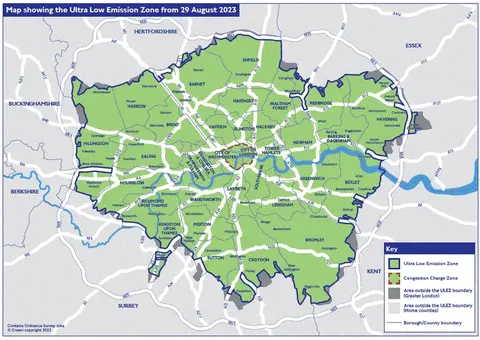
The ULEZ operates in across all London boroughs and the City of London. The M25 is not in the zone. 

Image
ulezdetailedmapgif

London ULEZ


Hours of Operation

The ULEZ is permanent.

Operating 24 hours a day, 7 days a week, every day of the year except Christmas Day (25th December).

Conversely, the “Congestion Charge” is only in effect from 07:00-22:00 on weekdays, excluding Christmas Day.


Minimum Emission Standards

  • Petrol: Euro 4
  • Diesel: Euro 6

These standards are more stringent for diesel (due to higher air quality impact), but they are both met by all plug-in hybrid vehicles (PHEV) and, of course, all full battery electric vehicles (BEVs).

Image
Smart Charge

Tip: A nice feature for low emission vehicle drivers of the ULEZ is there is no need to pre-register and pay an annual fee to claim your exemption - unlike the Congestion Charge system. The ULEZ portal simply calculates what fee is owed per day from your vehicle registration number.

#F2F5CF
#000000
#heading3
Discounts and Exemptions
H2

The following can claim some form of discount or exemption:

  • Vehicles for disabled users

  • Taxis

  • Wheelchair accessible private hire vehicles

  • Historic vehicles (built more than 40 years ago)

  • Agricultural, military, non-road going vehicles than can use the highway (e.g. excavators), some mobile cranes

  • Vehicles used for shows or performance

  • Not-for-profit minibuses

  • Heavier vehicles, including lorries (over 3.5 tonnes) and buses/coaches (over 5 tonnes)

Rules for each vary from blanket exemption to time-limited 100% exemption to partial discount. If these are relevant to your vehicle we recommend reading more about discounts and exemptions.

Pricing

  • £12.50 for most vehicle types, including cars, motorcycles and vans (up to and including 3.5 tonnes)

Payment

Payment must be made by midnight on the third day following the journey.

The following payment methods are accepted:

Online Payment

Pay via the payment portal that calculates what is due based on the day of access to the ULEZ and your vehicle’s registration number.

Phone Payment

You can pay over the phone with lines open Monday to Friday: 08:00-20:00 (excluding bank holidays).

  • UK: 0343 222 2222 (TfL call charges)

  • International: +44 343 222 2222

  • Textphone: 020 7649 9123 (if you have impaired hearing)

Auto Pay

Auto Pay bills you automatically every month for any Congestion Charges and ULEZ charges you may owe. Set up Auto Pay.

TfL Pay to drive in London app

TfL’s free app helps you pay your Congestion Charge, ULEZ and Low Emission Zone (LEZ) charges and manages the whole process.

Image
Smart Charge

Tip:

Whilst it can appear confusing which charges are owed for your trip, we strongly recommend using the online payment portal which calculates what is due based on the day of access to the ULEZ and your vehicle’s registration number.
 

The best way to set up Auto Pay for up to 5 vehicles and manage your details is through the app or by setting up a “London Road User Charging account” through the website.

#F2F5CF
#000000
#heading4
H2

Penalties and Enforcement

If you fail to pay (or make an error on your number plate or date of travel), you will be liable for the following penalty fees.

Vehicle Gross Vehicle Weight Penalty charge If paid within 14 days
Cars, vans, motorcycles, motor tricycles and mopeds 3.5 tonnes or less £160 £80
Motor caravans, ambulances 2.5 - 3.5 tonnes £160 £80
Minibuses (more than 8 passenger seats) 5 tonnes or less £160 £80
Image
Smart Charge

Tip: Paying the charge is much less painful than paying the penalty!

Better yet, drive an EV and forget all about it!

#F2F5CF
#000000
#heading5
London ULEZ vs LEZ vs Congestion Charge
H2

This section explains the difference between London’s three different traffic charging schemes.

ULEZ

Detailed above.

Low Emission Zone (LEZ)

The LEZ covers a wider area and affects commercial vehicles from large HGVs to small vans, pickup trucks and utility 4x4s. It is also permanently in effect. Full details about the Low Emission Zone are here.

Image
ez-london

Low Emission Zone (LEZ)

Congestion Charge Zone

Introduced in February 2003, the Congestion Charge Zone requires drivers to pay a fee for entering the centre of London between the hours of 07:00 and 22:00 each working day. Full battery electric and hydrogen fuel cell cars are exempt from the Congestion Charge Zone, though vehicles must pre-register each year to claim the exemption, and there are other exemptions.

Image
Smart Charge

Tip: Whilst it can appear confusing which charges are due for your trip, we strongly recommend using this portal which calculates what is due based on the day of access to the ULEZ and your vehicle's registration number.

#F2F5CF
#000000
Article read time
6 min read
H6
Summary
H2
  • Originally covering the same area as the London Congestion Charge zone, ULEZ expanded on 25 October 2021 to include the area up to (but not including) the North Circular and South Circular roads.

  • Financial charges are used to disincentivise drivers of the most polluting vehicles from driving within the zone.

  • These financial charges under the London ULEZ are in addition to the Congestion Charge, and failure to pay can result in penalty fees.

  • The London ULEZ is distinct from the Low Emissions Zone (LEZ) which covers a wider area and mainly affects commercial vehicles.

H6
Off

Member for

9 months 4 weeks
On
Image
Tethered-vs-Untethered-EV-Charger-Which-is-the-Best?

A guide comparing electric vehicle (EV) chargers with and without a permanently fixed charging cable.

#heading1
What is a tethered and untethered charger?
H2

If you’ve ever compared EV home chargers, you’d have come across the terms tethered and untethered. They simply mean that a chargepoint comes with a fixed (tethered) or without a fixed (untethered) cable.

Both will do the job of charging your electric car and have a number of advantages and disadvantages. When choosing between the two, you should consider which charger option suits you and your lifestyle best before investing in a device to charge your EV battery at home.

#F2F5CF
#000000
#heading2
What’s the difference between tethered and untethered chargers?
H2

The key difference is in the way the charging cable attaches to the device.

A tethered charger will be installed with a pre-fitted cable that cannot be removed. It’s fixed to the device, making it an irremovable part of the charger.

An untethered charger has no attached cable by default. In its place, you’ll find a socket. To charge your EV, you’ll need to plug your own cable into this socket.

Image
Tethered-vs-Untethered-EV-Charger-Which-is-the-Best?
#F2F5CF
#000000
#heading3
What is a tethered charger?
H2

If you’ve ever compared EV home chargers, you’d have come across the terms tethered and untethered. They simply mean that a chargepoint comes with a fixed (tethered) or without a fixed (untethered) cable.

Both will do the job of charging your electric car and have a number of advantages and disadvantages. When choosing between the two, you should consider which charger option suits you and your lifestyle best before investing in a device to charge your EV battery at home.

Advantages of a tethered charger

  • Quick and easy to use – No need to locate your cable and attach it to the device before charging your EV. You can simply plug the tethered cable into your electric car and charge.

  • Thief-proof – A cable that is tethered to your charger is harder to steal, so you’ll feel safer leaving it out.

Disadvantages of a tethered charger

  • Limited to a specific cable and connector – if you decide you want to change to a longer or shorter cable or switch the connector type after your charger is installed, you’ll have to change the whole charger.

  • Larger setup - tethered chargers take up more space than a charger without a fixed cable, which might not be for you if you're after a super sleek and simplistic look.

  • Cost – The addition of the cable means tethered chargers cost more than untethered chargers. If you already have the right cable for your EV and you don’t plan on changing your EV anytime soon, the extra cost becomes an unnecessary expense.

#F2F5CF
#000000
#heading4
What is an untethered charger?
H2

An untethered charger has no permanently attached cable. It’s sometimes also referred to as a universal charger because it has a socket which allows you to plug in cables with different types of connectors.

You can learn more about EV charging connector types in our guide.

Advantages of an untethered charger

  • Minimalist look – No fixed cable means an untethered charger takes up less space, allowing for a sleeker design.

  • Cheaper option – Untethered chargers tend to cost less than tethered equivalents because you don’t have to pay for the cable. If you already have a compatible charging cable, you’ll be able to save money when opting for a untethered charger.

  • Flexibility and future-proofing – You’re free to change your cable and connector without having to replace the entire charger.

Disadvantages of an untethered charger

  • No cable, no charging – You have to remember to bring your cable or where it was last stored. If you use your charging cable away from home and forget to bring it back, you won’t be able to use your home charger.

  • Less convenient – Having an untethered charger requires you to unpack, plug, unplug and pack away your cable every time you use your home charger, which takes more time than simply plugging in a tethered cable.

  • Not for the forgetful - Once you’re done charging you need to remember to unplug the cable and pack it away. If you don’t, it could in theory be unplugged by anyone.

#F2F5CF
#000000
#heading5
Which is better – tethered or untethered?
H2

Objectively, no charger is better than the other, so the choice between tethered and untethered is up to your preferences and requirements. Untethered chargers are generally more flexible as they allow you to change your cable to suit your needed length and connector type, which is great if you plan to regularly change your electric car. On the other hand, tethered chargers offer easier everyday use and come with cables that are longer than common cables used with tethered chargers.

The key things to consider before making your choice are:

  • Convenience

  • Cable length

  • Cost

  • Charging frequency

  • Aesthetics

#F2F5CF
#000000
Article read time
5 min read
H6
Summary
H2

Whether a tethered or untethered EV charger is best for you depends on your budget, how much convenience matters to you, and your aesthetic preferences.

#F2F5CF
#000000
#F2F5CF
#000000
H6
Off

Member for

9 months 4 weeks
On
Image
Can-You-Charge-an-Electric-Car-With-an-Extension-Cable?

A guide looking at the possibility of using an extension cable to charge an electric car.

#heading1
Charging without an EV home charger – is it possible?
H2

With a growing number of electric vehicles (EVs) on the road comes the need for flexible and reliable charging solutions. For many EV drivers, the ability to charge their cars conveniently at home is important. If you’re lucky, you’ll have a drive or private off-street parking to install a dedicated home charger.

Electric car owners without a driveway or off-street parking can use public charging like fast chargers at supermarkets and on parking lots or rapid chargers found off motorways to keep their batteries charged. But what if you still want to charge at home? In this guide, we’ll find out if it’s possible to charge an electric car with an extension cable plugged into a standard 3-pin socket at home.

#heading2
Charging an electric car with an extension cable
H2

Whilst it is possible to charge an electric car with an extension cable using a standard 3-pin plug, this method of charging is generally not recommended. Experts and safety groups including Electrical Safety First advise against the use of extension cables to charge an electric car at home because of the associated safety risks.

Extension cords aren’t typically made to handle the high and sustained current needed for EV charging over extended periods. Carrying these high loads for sustained periods of time can lead to potential hazards such as overheating or electrical fires. Charging with an extension cable and 3-pin plug is also very slow. For example, a domestic 2.4kW socket takes over 24 hours to charge a 60kWh EV battery. By comparison, a 7kW EV home charger is around three times faster, and significantly safer. Because it takes so much longer with a 3-pin plug than a dedicated EV charger, the danger of overheating is compounded because you may have to leave an extension cord and the electric car charging unattended overnight or while you’re not at home to get enough charge.

#heading3
Safety tips for using extension cables for EV charging
H2

If you have to use an extension cable to charge your EV in an emergency, you should follow these simple tips to stay safe:

  • Select the right type of extension cable – Use an extension cord that is capable of handling the charging load. Opt for one that is made for outdoor use and rated at least 13 Amps.

  • Check the cable frequently – Always keep an eye on the charging process when using an extension cable. If you notice any signs of damage or overheating, stop charging immediately.

  • Follow the manufacturer’s guidelines – Check your EV’s instructions and any guidelines provided on the use of accessories like extension cables for charging.
Article read time
3 min read
H6
Summary
H2

Yes, you can charge an electric car with an extension cable using a 3-pin plug, but should you? If you can avoid it, we don’t recommend it as there are potential hazards like overheating and electric faults which could cause fires. Ideally, extension cables should only be used in emergencies, and always charge when you can monitor the process - i.e. not overnight.

H6
Off

Member for

9 months 4 weeks
On
Image
Hit-the-road-happy-III
Categories

A guide highlighting the differences between driving an electric vehicle (EV) and a traditional combustion engine (ICE) car.

#heading1
Learning to drive an electric car
H2

When you switch from an ICE car to an EV, it may take some time to adjust to all the ways driving an electric car differs (for the better) from a combustion engine car. But EVs are in no way difficult or harder to drive, and the benefits of driving an EV outweigh the time spent learning and adjusting.

EVs are cheaper and more sustainable to run than petrol or diesel cars. They’re capable of doing long journeys if you plan your charging stops and won’t need charging all too often, especially if you know how to optimise your battery range.

In this article, we want to focus on a less-discussed topic in the EV world that plenty of drivers wonder about – how it feels to drive an EV vs an ICE car.

#heading2
What’s the difference between driving an EV and an ICE car?
H2

Driving an EV is different from driving an ICE car in a few ways:

  • EVs are quieter

  • All EVs are automatic

  • EVs have faster acceleration

  • EVs have regenerative braking

  • EVs offer a smoother driving experience

EVs are quieter

EVs reduce noise pollution because they’re quieter than ICE cars. The electric motor doesn’t rely on combustion and numerous mechanical parts to switch gears and accelerate, resulting in less noise. In fact, they’re so quiet that EVs are fitted with an artificial noisemaker to improve safety by alerting pedestrians of approaching vehicles.

All EVs are automatic

EVs don’t have a traditional gearbox with manual transmission. Instead, they have a simplified version of an automatic transmission with a single-speed motor.

An automatic car is generally smoother and more comfortable to drive, has increased efficiency, and requires less maintenance thanks to the simplified mechanics.

Automatic cars including EVs have no clutch or gears, which reduces the foot pedals in your car to just two – the accelerator and brake.

EVs have faster acceleration

The electric motor in EVs can generate maximum torque instantly, which provides faster acceleration as opposed to the more gradual feeling of acceleration and gear shifts you experience in an ICE car.

EVs have regenerative braking

EVs harness the power of regenerative braking, which repurposes energy that would otherwise be lost when slowing the car down. It improves efficiency by slightly charging your EV on the go and can bring the overall cost of driving it down.

EVs offer a smoother driving experience

Good EV tyres significantly improve the comfort of your driving experience, because they reduce vibration and absorb road irregularities. Plus, fewer moving parts and the low centre of gravity in an EV make driving and handling an EV feel smoother and stable.

#heading3
Are electric cars difficult to drive?
H2

No, drivers typically find electric cars easier and more intuitive to drive than most traditional ICE cars, especially manual ones. The automatic transmission removes the need for gear shifting, letting you focus on the road. Many drivers also find the acceleration mechanism simpler to manage.

#heading4
Can I take my driving test in an electric car?
H2

Yes, you can take your driving test in an electric car and even do your driving lessons in one. If you pass your test in an EV, you’ll receive a Category B Auto licence. This limits you to driving ICE and electric cars with automatic transmissions only.

If you want to drive a manual car in the future, you’ll need to pass a Category B driving test, which will allow you to drive manual and automatic transmission cars.

#heading5
How driving an electric car is different to traditional cars
H2

Driving an electric car offers more responsiveness and comfort than most traditional cars. They’re quieter, easier to drive and accelerate faster, providing an enjoyable driving experience. The increasing excitement around electric motorsports, including Formula-E, highlights the performance capabilities and fun that electric driving can offer.

While there’s a difference in driving and handling EVs compared to ICE cars, electric driving offers clear benefits to the driver and environment. Read more about the benefits of driving an EV in our guide.

Article read time
4 min read
H6
Summary
H2

Driving an electric car generally offers more comfort and responsiveness than travelling in an ICE car. You’ll notice less noise, better traction and quicker acceleration when driving an EV.

H6
Off

Member for

9 months 4 weeks
On
Image
mgzsev-lifestyle-image

A guide exploring which electric car has the best range in the UK and comparing the ten longest range electric vehicles (EVs) currently available.

#heading1
Finding an electric car with the best range
H2

As the uptake in EVs continues to rise, more people are set on finding and purchasing an electric car with the best range. But is more always necessary?

The typical car drives roughly 127 miles per week, while the average range of an electric car is around 236 miles. You should weigh up the cost of purchasing an electric car with a long range (at a higher cost) vs the benefit to your day-to-day life. A low to mid-range EV may just be enough for your needs.

Whether you choose a 300-mile electric car, go beyond the 400-mile range mark, or opt for an EV with an average range, the public charging network in the UK makes it fairly easy for you to top up your battery. More than 32,500 public charging locations are available – that’s up 47% in just one year since early 2023.

#heading2
Top 10 electric cars with the longest range in the UK
H2

Gone are the days of 300-mile range electric cars being the longest range money could buy. Today, there are several EVs available on the UK market that go beyond the 400-mile mark. We’ve crunched the numbers to create an electric car range comparison of the top 10 EVs by range.

Top 10 electric car range list from highest to lowest:

  1. Mercedes-Benz EQS Saloon (452 miles)

  2. Fisker Ocean Extreme (440 miles)

  3. Polestar 2 (406 miles)

  4. Porsche Taycan 4S (399 miles)

  5. Tesla Model S (394 miles)

  6. Polestar 3 (392 miles)

  7. Tesla Model 3 Long Range (390 miles)

  8. BMW i7 (387 miles)

  9. Volkswagen ID.7 Pro Match (384 miles)

  10. BMW iX (382 miles)

#heading3
1. Mercedes-Benz EQS Saloon (452 miles)
H3

The Mercedes-Benz EQS saloon is currently the electric car with the

Image
Mercedes-EQS-lifestyle-image

longest range available in the UK. It has an unbeatable range of 452 miles on a single charge. That’s technically enough to take you from London to Manchester and back without a single charging stop.

The Mercedes-Benz EQS is a high-end electric car that comes at an equally high price, starting from £129,470. The model is also available as an SUV, which offers more space but less range.

#heading4
2. Fisker Ocean Extreme (440 miles)
H3

Fisker is a US-based electric carmaker that offers three SUV models in its Ocean series. The Ocean Sport is the entry-level model with a respectable range of 237 miles, followed by the Ocean One with 379 miles, and the Ocean Extreme at a whopping 440 miles.

The two electric motors in the Fisker Ocean Extreme provide all-wheel drive, and the big boot space offers plenty of room, making it a very stylish and practical family car. Prices for the Ocean Extreme start from £57,900.

#heading5
3. Polestar 2 (406 miles)
H3
Image
polestar-2-lifestyle

The updated Polestar 2 has a 406-mile range – that’s the third longest range for any electric car currently available in the UK. Offering a top infotainment system and the choice between rear- or all-wheel drive, prices for the Polestar 2 start from £44,950.

#heading6
4. Porsche Taycan 4S (399 miles)
H3

The Porsche Taycan 4S is a joy to drive and will let you go up to 399 miles on a single charge when opting for the Performance Battery Plus. It has everything you’d expect from an electric sports car, including rapid charging of up to 270kW, all-wheel drive and outstanding design on the inside and outside.

This sports car isn’t cheap, but that is expected from a manufacturer like Porsche. The Taycan 4S starts from £95,900 and costs more with the battery upgrade that allows you to hit that near 400-mile range.

#heading7
5. Tesla Model S (394 miles)
H3
Image
tesla-model-s-lifestyle-image-2022

Tesla’s Model S is the manufacturer’s top-range saloon. The electric car is available in various configurations, offering a 394-mile range with dual motor all-wheel drive. It comes with all the tech you expect from Tesla and is compatible with rapid charging of up to 250kW. You can purchase the Model S from £93,480.

The Tesla Model S is not to be confused with the Model S Plaid, which trades some of its range for more speed. One downside of the Model S for UK drivers is that the electric car is currently only available as a left-hand drive.

#heading8
6. Polestar 3 (392 miles)
H3
Image
polestar-3-lifestyle

The Polestar 3 is the flagship SUV offering from the Swedish carmaker. It’s a spacious ride with plenty of legroom for passengers and a modern, minimalist interior. According to Polestar, this EV “drives like a sports car” and can take you up to 392 miles on just one full charge.

The Polestar 3’s dual motor all-wheel drive, sizable range and stylish appearance will set you back at least £75,900 for the base model.

#heading9
7. Tesla Model 3 Long Range (390 miles)
H3
Image
model-3-21-lifestyle

The carmaker’s more affordable saloon model, the Tesla Model 3, had a recent refresh, and the Long Range configuration is claimed to cover an impressive 390 miles on just a single charge. Like the Model S, it comes with a dual motor all-wheel drive and rapid charging of up to 250kW.

Prices for the Tesla Model 3 Long Range start at £49,000, while the Model 3 base model is available from £39,000.

#heading10
8. BMW i7 (387 miles)
H3
Image
bmw-i7-lifestyle

The BMW i7 is a premium electric car with prices starting from £101,765. For this price, you get a range of up to 387 miles and luxurious interiors. There are also some unique features in the BMW i7, such as a top-quality sound system and touchscreens integrated into rear doors for infotainment controls. Is it worth the £100k+ price tag? Well, that’s for you to decide.

#heading11
9. Volkswagen ID.7 Pro Match (384 miles)
H3

The only VW making this top 10 is the Volkswagen ID.7 in the Pro Match edition. It’s one of the more affordable electric cars with a long range in this comparison, starting from £55,870.

The ID.7 Pro Match has a maximum range of 384 miles according to Volkswagen. That’s almost identical to the range of the BMW i7 which costs nearly twice as much.

This mid-range electric car comes with a lot less fancy features and extras than pricier competitors on this list, offering good value for money to anyone looking to maximise their range on a smaller but still sizeable budget.

#heading12
10. BMW iX xDrive50 (382 miles)
H3
Image
bmw-ix3-lifestyle

Last but not least, another all-electric car from the BMW i range is the iX. It’s a luxury SUV featuring 5G connectivity, advanced infotainment and air suspension for a comfortable driving experience. The cabin offers plenty of room for passengers and a lot of storage space in the boot.

The BMW iX is available in three different models, with the xDrive50 providing up to 382 miles on a single charge. Prices for the iX start from £70,985.

#heading13
Real-world electric car range vs WLTP
H2

The manufacturer’s reported range and the real-world electric car range that can be achieved typically differ. The World Harmonised Light Test Procedure (WLPT) is a standardised way of testing and determining an EV’s range in specific conditions. For this test, an electric car will travel in warm temperatures at an average speed of 28.8 mph, starting from 100% state of charge and going all the way down to 0%.

When you’re driving in the real world, an EV will likely achieve less miles than stated in the WLTP range. You’re more likely to use your battery between 20% and 80%. Plus, several factors can impact an electric car’s range, including the weather, your driving habits, road conditions, and overall weight.

#heading14
Tips for maximising electric car range
H2

Adopt good driving habits

The way you drive can greatly affect your electric car’s range. Fast acceleration, driving at the top of the speed limit and long journeys on motorways and A roads will generally result in a lower range.

Instead, try to accelerate gently, avoid hitting the top of the speed limit (unless needed) and use regenerative braking to repurpose energy will help you get closer to your WLPT range.
 

Curb your energy usage

Turning the A/C all the way up will eat into your range. Equally, heating your cabin and seats to the extent that you have to take off layers of clothes is wasteful. So when you can, avoid excessive heating or cooling to save energy.

If you have to pre-condition your electric car during colder months to bring the battery up to temperature for better efficiency, make sure your EV is plugged into your home charger. You’ll use up energy, but you won’t drain your battery just to warm up your vehicle this way.
 

Do regular maintenance

Checking your tyre pressure, especially when temperatures and seasons change, should be on your to-do list. Low pressure can lead to more rolling resistance, which in turn makes your electric car more inefficient.

For more tips on how to optimise the range of your electric car, read our guide.

Article read time
9 min read
H6
Summary
H2

The Mercedes-Benz EQS saloon has an unbeatable range of up to 452 miles, making it currently the electric car with the longest range that you can purchase in the UK.

H6
Off